

Not long ago, Moloco was one of the main traffic sources for many affiliate teams. Teams moved there after issues with Meta and also used it to scale their winning combos. As volumes grew, so did the number of agencies through which teams worked with the platform, making the mass blocking of agency accounts a serious problem for the entire market.
The changes also affected RentAcc agency accounts. We monitored the market throughout this period and are ready to share our observations. We’ll explain what ultimately changed in the market after the Moloco bans, which sources took over the freed-up volumes, where iGaming teams are moving, and how the overall in-app traffic landscape has changed.
Current Realities of Working with Moloco
Moloco was actively preparing for an IPO, although it never announced this publicly. Around three months before the mass blocking, some teams started noticing unusual storms that had not occurred before, but no one could have expected it to end with agency accounts being frozen without any explanation.
On the night of June 3–4, campaigns stopped, new campaigns could no longer be launched, and all funds were fully returned to RentAcc clients. Rumors also began circulating across the market that the freezes were related to a large-scale audit of agency accounts and tighter rules for working with partners. The restrictions affected all agencies in the EMEA and Asia regions, making further work impossible.
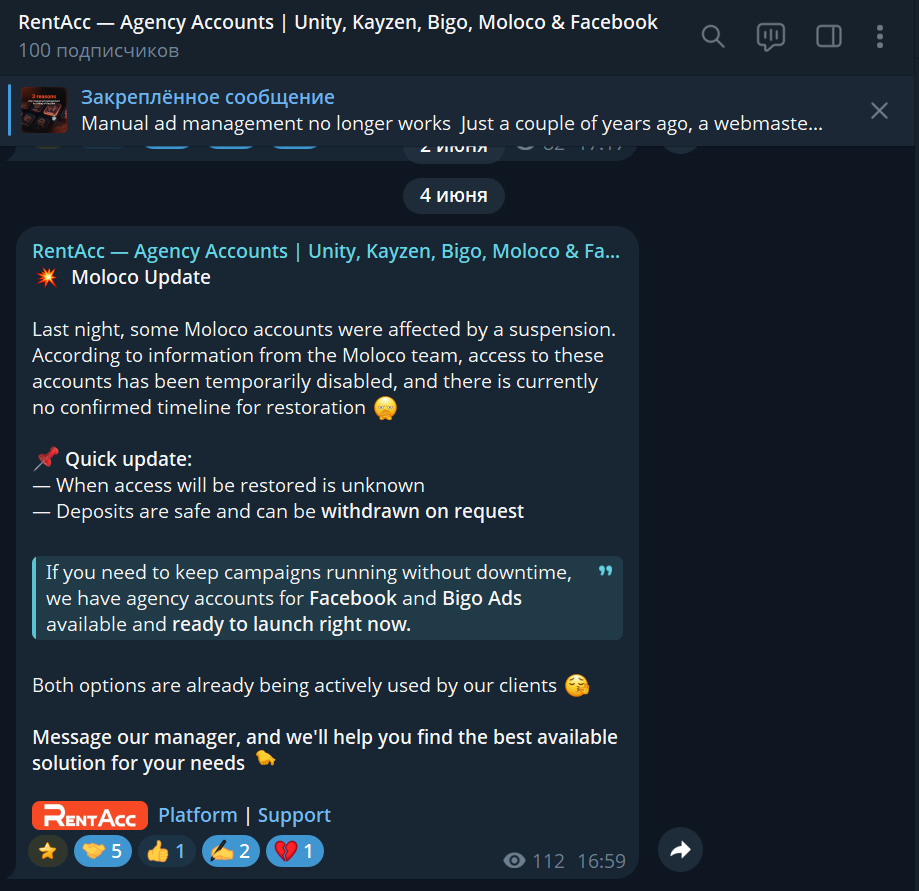
Such serious restrictions came as a real shock, as large client budgets were being managed through agency accounts, while teams were planning to scale further. The situation was further aggravated by the start of the World Cup, for which many teams had prepared volumes in advance. The market found itself in a situation where it had to urgently look for new accounts and move budgets to other platforms.
This is not the first time major platforms have introduced mass restrictions without any prior notice. However, the scale of the Moloco bans and the lack of clear information about the reasons behind them created serious tension in the market. The RentAcc team immediately offered clients to diversify their platforms and redistribute budgets to alternative sources — primarily Unity Ads, Bigo, and Kayzen. The market was reluctant to embrace these changes, as no one knew what kind of results to expect from less popular platforms, but there were few alternatives left.
Today, Moloco continues to work with white-hat verticals, but access for iGaming is effectively closed. More compliant options remain available, including approved formats such as Social Casino. Some teams tried to return with their old winning combos, but quickly ran into restrictions. The platform has also explicitly stated that it can detect gambling apps built on WebView, meaning that even available agency accounts do not guarantee that such apps can be launched.
Meanwhile, the RentAcc team has built up extensive experience working with Unity, published numerous articles and guides about the source, and can now share this expertise with clients. If you need to launch quickly without the risk of account restrictions, platform managers will consult you at every stage, provide creative recommendations for passing moderation faster, and help set up MMP attribution.
How Did Media Buyers Adapt?
Those who were actively running in-app traffic did not stop after the issues with Moloco, but instead began redistributing their budgets across other sources. First and foremost, attention shifted to Unity Ads, Kayzen, and BIGO. These platforms became the main sources for testing and further scaling in-app campaigns. At the same time, each of the three platforms has its own specifics.
| What does it offer? | Key features | |
| Unity Ads | Supports launches for apps published in the store as well as APKs without publishing them on Google Play. | Allows you to run ROAS campaigns, but this type of optimization requires post-install data, and a new campaign goes through a learning phase. |
| BIGO Ads | BIGO allows you to acquire both social and in-app traffic simultaneously through Imo, Likee, and a network of 50,000+ partner apps; launches can be made to an app or a link. | Supports website promotion, pixel tracking, and server-to-server data transmission. Stable campaign performance requires correct setup and properly prepared creatives. |
| Kayzen | Control over segments, placements, and formats, as well as app-to-web and retargeting. Its proprietary bidding system provides greater control over bids. | A native app is required; PWA and WebView are not supported. Optimization is available for CPM, CPC, CPI, and CPA. Detailed publisher-level statistics are provided. |
Each of these sources has its own mechanics and strengths. In some cases, algorithmic optimization plays a bigger role, while in others, performance depends more heavily on the quality and type of the app. Some platforms require a budget for algorithm learning, while others rely more heavily on proper MMP integration. If we are talking about the most straightforward option for switching over, Unity Ads is currently the most obvious choice.
When moving winning combos, it is important to preserve what has already delivered results:
- creatives;
- landing pages;
- offers;
- test results;
- winning combos.
All of these elements represent a ready-made foundation for adapting to new platforms, and it can and should be used. The Moloco situation also demonstrated the risks of relying on a single source. If a platform suddenly becomes unavailable, all the volume running through it stops as well. Thanks to this experience, media buyers have learned to distribute budgets across multiple sources more quickly and test new platforms instead of relying on a single channel.
Conclusion
The mass blocking of Moloco agency accounts became one of the most notable events in the mobile advertising market in 2026. There are still no official explanations, but the situation showed how quickly teams have to restructure their workflow when a familiar source suddenly becomes unavailable. Teams are actively distributing budgets across Unity Ads, BIGO, Kayzen and other in-app platforms, while preserving winning combos and testing new sources.
RentAcc helps organize work on a unified CRM platform through flexible team access. The interface allows you to set up roles for everyone: owner, team lead, buyer, and finance manager — so each team member has unique permissions and sees only what they actually need for their work. Contact the official RentAcc bot and tell us which advertising platform you are interested in and which vertical you work with to get professional advice and start working as quickly as possible.
Go to RentAcc | Telegram Bot | Latest news
RentAcc is a platform for working with Facebook and in-app — ready-made agency accounts and automation. Suitable for solo buyers and teams who value stability, transparency, and a technological approach.
Commission: 4 to 10%
Inside the platform:
— agency accounts for any verticals and GEOs
— free replacements and money-back guarantee
— centralized control of spending
— technical support for launches
— instant notifications in the TG-bot


Sending the message, you agree to follow by the terms of our. Privacy policy.